Noise
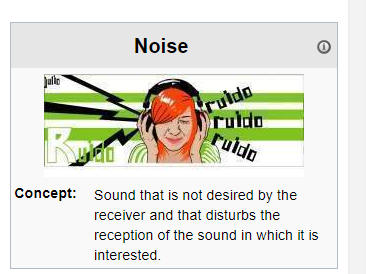
Noise (sound) . In the environment , noise is defined as any unwanted sound. From that point of view, the most excellent music can be classified as noise by the person who at a certain moment wants or does not want to hear it.
The expression noise as a synonym for noise pollution, refers to a noise (sound), with a high intensity (or a sum of intensities), which can even be harmful to human health. Against excessive noise, earplugs and earmuffs (ear helmets, which contain electronics that reduce the dB of outside noises, reducing them or making your hearing more pleasant) are used to prevent hearing loss. (which, if left unchecked, can lead to deafness).
On the contrary, noises are also simple or complex sounds but disharmonic and of very high intensity, generating intolerance or pain in the ear and a feeling of displeasure to the individual.
Summary
[ disguise ]
- 1 Limits
- 2 Noise pollution
- 3 Effects of noise on health
- 1 Auditory effects
- 1.1 Temporal shift of the hearing threshold
- 1.2 Permanent shift of the hearing threshold
- 2 Interference in oral communication
- 3 Non-auditory effects
- 3.1 Psychopathological effects
- 3.2 Psychological effects
- 4 Other effects
- 1 Auditory effects
- 4 Sources
Boundaries
Emitting entities can produce a high level of noise, but the limits are adjusted to the sensory capacity of the person, where the noise (sound) goes from being tolerable to harmful, environments with more than 65 decibels (dB) are considered unacceptable. .
Below 80 dB the human ear does not present definitive alterations. These levels generate temporary discomfort called auditory fatigue, where the transducer elements (inner ear) do not suffer definitive problems. When the intensity exceeds 90 dB, larger irreversible injuries begin to appear, the greater the exposure and personal susceptibility.
Noise pollution
Excess sound that alters the normal environmental conditions in a certain area is called noise pollution (or noise pollution). Although noise does not accumulate, move or persist over time like other pollution, it can also cause great damage to people’s quality of life if it is not adequately controlled. The main causes of noise pollution are those related to human activities such as transportation, the construction of buildings and public works, industries, among others.
Effects of noise on health
Noise in the home.
Auditory effects
The auditory system suffers from prolonged exposure to a noise source, even if it is low level.
The hearing deficit caused by environmental noise is called socioacousia.
When a person is exposed to an excessive noise level for a long time, they notice a whistling sound in the ear, this is an alarm signal. Initially, the damage caused by prolonged exposure is not permanent; it disappears after 10 days. However, if exposure to the noise source does not stop, the injuries will be permanent. Deafness will grow until hearing is completely lost.
Not only is prolonged noise harmful, a sudden sound of 160dBa, such as that of an explosion or gunshot, can pierce the eardrum or cause other irreversible injuries.
Temporal shift of the hearing threshold
It consists of an elevation of the threshold produced by the presence of a noise, with full recovery after a period, as long as the exposure to it is not repeated. It usually occurs during the first hour of exposure to noise.
Permanent shift of the hearing threshold
It is the same effect described above but aggravated by the passage of time and exposure to noise. When someone is subjected to numerous exposures and for long periods (several years), the recovery of the threshold becomes increasingly slower and more difficult, until it becomes irreversible. The permanent shift of the hearing threshold is directly linked to presbycucia (loss of hearing sensitivity due to the effects of age). The deafness caused by the permanent displacement of the hearing threshold affects both ears and with identical intensity.
Interference in oral communication
Communication intelligibility is reduced due to background noise. The ear is a transducer and does not discriminate between noise sources, the separation and identification of sound sources occurs in the brain . As is already known, the human voice produces sound in the range of 100 to 10000Hz, but verbal information is in the range of 200 to 6000Hz. The frequency band determined for speech intelligibility, that is, understanding words and phrases, is between 500 and 2500 Hz. Interference in oral communication during work activities can cause accidents caused by the inability to hear warning calls or other indications.
Non-auditory effects
Noise pollution, in addition to affecting the ear, can cause negative psychological effects and other pathophysiological effects. Of course, noise and its negative non-auditory effects on behavior and mental and physical health depend on personal characteristics; it seems that the stress generated by noise is modulated depending on each individual and each situation.
Psychopathological effects
At more than 60 dBa :
- Dilation of the pupils and accelerated blinking.
- Respiratory agitation, pulse acceleration and tachycardia.
- Increased blood pressure and headache.
- Less blood flow and greater muscle activity. The muscles become tense and painful, especially those in the neck and back.
At more than 85 dBa :
- Decreased gastric secretion, gastritis or colitis.
- Increase in cholesterol and triglycerides, with the consequent cardiovascular risk. In patients with cardiovascular problems, arteriosclerosis or coronary problems, loud and sudden noises can even cause a heart attack.
- Increases blood glucose. In diabetes patients, continued elevated blood glucose can cause long-term medical complications.
Psychological effects
- Insomnia and trouble falling asleep.
- Stress (due to the increase in stress-related hormones such as adrenaline). Depression and anxiety.
- Irritability and aggressiveness.
- Hysteria and neurosis.
- Social isolation.
- Lack of sexual desire or sexual inhibition.
Other effects
Effects on sleep
Noise causes difficulties in falling asleep and wakes up those who are asleep. Sleep is an activity that occupies a third of our lives and allows us to rest, organize and project our consciousness. Sleep is made up of two types: classic deep sleep (deep sleep stage), which in turn is divided into four different phases), and on the other hand there is paradoxical sleep. It has been shown that sounds of the order of approximately 60 dBA reduce the depth of sleep, with this decrease increasing as the amplitude of the frequency band increases, which can wake up the individual, depending on the phase of sleep in which they are found. and the nature of the noise. It is important to keep in mind that weak, surprising stimuli can also disturb sleep.
Effects on behavior
Noise produces momentary alterations in behavior, which consist of aggressiveness or showing an individual with a greater degree of disinterest or irritability. These alterations, which are generally temporary, occur as a result of a noise that causes concern, insecurity or fear in some cases.
Effects on memory
In those tasks where memory is used, it has been shown that there is greater performance in those individuals who are not subjected to noise, because this produces growth in the subject’s activation and this in relation to performance in Certain types of tasks produce over-activation, resulting in decreased performance. Noise makes articulation in a review task slower, especially when dealing with unknown or longer words, that is, in noise conditions, the individual is psychologically exhausted to maintain his or her level of performance.
Effects on attention
Noise prevents attention from being focused on a specific activity, causing it to be lost in others. Losing this way the concentration on the activity.
Effects on children
Noise has a negative impact on children’s learning and health. When children are educated in noisy environments, they lose their ability to attend to acoustic signals, suffer disturbances in their ability to listen, as well as a delay in learning to read and verbal communication. All these factors favor the isolation of the child, making him unsociable.