The Family Recipe Book: Why Your Grandmother’s Handwriting Deserves a Better Home Than a Shoebox
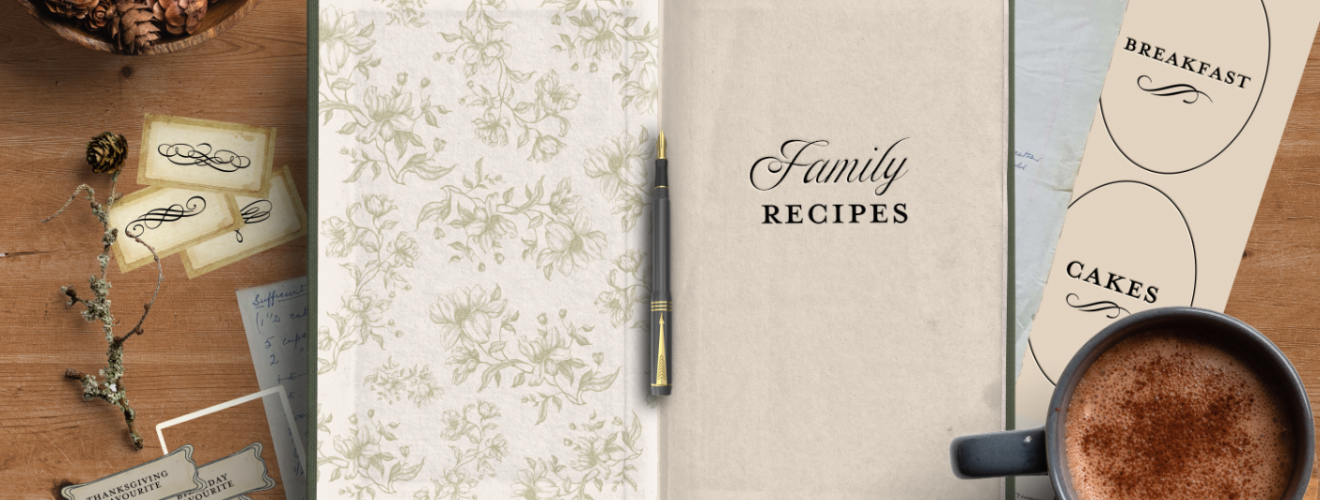
Every family has one: a shoebox, a kitchen drawer, or a stack of index cards held together with a rubber band, full of recipes written in handwriting that’s slowly fading. Maybe it’s your grandmother’s biscuit recipe, splattered with decades of flour and butter. Maybe it’s a stack of napkins with a friend’s chili recipe scrawled on the back. These recipes carry more than instructions. They carry the people who made them, and that’s exactly the gap the Family Recipe Book from Duncan & Stone is built to fill.
More Than a Blank Cookbook
At first glance, it looks like a simple fill-in-the-blank cookbook, and functionally, that’s exactly what it is. But the design choices make clear this is meant to hold more than ingredient lists. Duncan & Stone describes the book as a way to capture “the people, places and moments” behind family meals, not just the recipes themselves. That distinction matters. A recipe without context is just a set of steps. A recipe with a note about who taught you to make it, or what holiday it was always served at, becomes a piece of family history.
What’s Actually Inside
The book is organized into six recipe sections, each with room for about ten recipes: Breakfast, Appetizers, Soup and Salad, Main Dishes, Side Dishes, and Desserts. That’s roughly 60 recipes total, enough to hold a genuine cross-section of a family’s cooking rather than just a handful of favorites.
A few details set it apart from a generic recipe journal:
A flat-lay spine. Anyone who has fought with a cookbook that won’t stay open on the counter will appreciate this. The book is designed to lie flat while you’re actually cooking, which sounds like a small thing until you’re holding a spatula in one hand and trying to keep pages open with the other.
A spill-resistant hard cover. Recipe books live in kitchens, which means they live near flour, batter, and the occasional overturned measuring cup. A spill-resistant cover means the book can survive actual use rather than being kept pristine on a shelf, purely decorative.
A cooking conversion chart. A practical addition that saves a trip to the internet mid-recipe.
Blank pages and a rear storage pocket. Space for recipes that don’t fit the six categories, or for tucking in the actual handwritten card, a photo, or a newspaper clipping that came with the original recipe.
Gold embossed title and spine, available in two styles, Cottage and Citrus, giving it a finished look worth displaying rather than hiding in a drawer.
Why It Works as a Gift
Duncan & Stone positions the Family Recipe Book as an ideal gift for newlyweds and housewarming parties, and the logic holds up. A new household is exactly the moment when someone starts actively building their own collection of go-to recipes, often by asking parents and grandparents to finally write down the dishes that were never measured, just made by feel. A structured book gives that collecting project a home from day one, instead of the recipes accumulating as scattered notes that get lost in a move.
It also works in the other direction: as a gift for the person who already has decades of recipes to consolidate. Anyone who has inherited a box of index cards after a family member passes knows the anxiety of handling paper that’s the only copy of something irreplaceable. Transferring those recipes into a proper book, one built to survive kitchen use, is both a practical fix and a quiet act of preservation.
One Honest Limitation
It’s worth noting plainly: the book is pre-printed and not personalized. There’s no name embossed on the cover, no custom section titles. What you get is a well-designed, sturdy structure, and the personalization comes entirely from what you write inside it. For some buyers, that is exactly the point. The book gets out of the way and lets the recipes and the handwriting be the personal part. For someone specifically looking for a monogrammed or name-customized keepsake, it’s a fair thing to know going in.
Starting Your Own
If you’re thinking about starting one, the easiest approach is to not wait for a complete plan. Pick one recipe you already know by heart and write it down first, notes and all. Then start asking. A phone call to a parent or grandparent asking them to describe how they make a specific dish, in their own words, often produces exactly the kind of detail that turns a recipe into a story: the substitution they always make, the dish it reminds them of, the person who taught it to them.
A shoebox of recipe cards can be lost in an afternoon. A book like this, built to survive the kitchen it lives in, is meant to still be in use decades from now, handed down the same way the recipes inside it were.