Crustacean
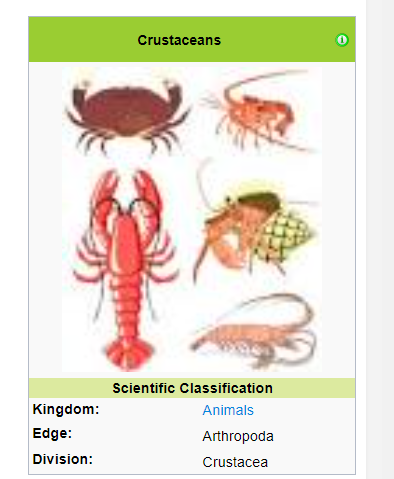
Crustaceans . They are mostly aquatic arthropods , although there are terrestrial species of very varied shapes, of which there are about 26,000 living species.
Summary
[ disguise ]
- 1 History
- 2 Morphology of a Crustacean
- 3 Other features
- 4 Classification of Crustaceans
- 1 Entomostraceans
- 2 Cephalocarids
- 3 Branchiopods
- 4 Copepods
- 5 Ostracods
- 6 Branchhiuras
- 7 Mystacocarids
- 8 Cirripeds
- 9 Malacostraceans
- 10 Cumaceous
- 11 Leptostraceans
- 12 Syncharides
- 13 Isopods
- 14 Mysidaceans
- 15 Hoplocarids
- 16 Eucarids
- 17 The euphausiaceae
- 18 Zooplankton or “krill”
- 19 Macruros
- 5 Shrimp
- 6 The common crab
- 7 Crayfish
- 8 Sources
History
Like all arthropods, crustaceans have an external skeleton (exoskeleton) and their body is made up of a series of segments; each of them usually carries a pair of appendages that are at least primarily biramous; some of the adult appendages continue to retain this characteristic. The number of segments varies from 16 to more than 60. The most primitive crustaceans are those with the greatest number of segments while the most evolved ones have fewer segments. Over the course of evolution, the segments and other parts of the body have become specialized. The appendages, which are used for breathing, swimming, locomotion, and feeding, may be highly modified into jaws, reproductive organs, and other structures, or may have been simplified or lost.
In general, the head is fused with a series of thoracic segments forming a region called the cephalothorax, which is followed by the abdomen. Part or all of the body is usually covered by a shell called the carapace. On the head there are two pairs of sensory organs (antennae) and a pair of jaws, behind which there are two other pairs of maxillae. The head usually has a pair of compound eyes, an odd eye, or both.
The cephalothorax usually has appendages, which are used in locomotion and respiration. The shell often serves as a protective cover for the gills, which are part of the limbs. Some limbs may form pincers (chelae). The abdominal appendages may be used for locomotion, but they often perform other functions, such as breathing, and tend to be small in size. The telson, a part of the tail in which the anus goes, is sometimes used for swimming.
The main cavity of the body is the hemocoel, occupied by an ‘open’ type circulatory system through which blood is propelled by a dorsal heart. The digestive system is essentially a straight tube, often with a kind of gizzard-like gastric grinder used to break up food, and a pair of digestive glands that not only secrete digestive juices, but also absorb food. Near the antennae there are excretory structures that act as kidneys. They have a brain that takes the form of ganglia next to the sensory organs, and under the intestine are a series of important ganglia and nerves.
Morphology of a Crustacean
The body is divided into :
- Cephalothorax or portion frequently covered by a shell.
- Abdomen or pleon that can be formed by segments and ends in the furcation.
- Head or cephalon with compound and pedunculated eyes and two pairs of antennae, mouth appendages with mandibles, maxillae and maxillipeds.
- Abdominal legs or pleopods that serve as copulatory and ovigerous organs. Ambulatory legs or pereiopods.
Other features
- Gill respiratory system.
- Excretory system formed by glands,
- Sexual reproduction with separate sexes.
- Development with various larval stages
- complex nervous system
The larval forms of crustaceans are part of the marine “zooplankton”.
Classification of Crustaceans
- Entomostraceans or lower crustaceans. They are small, with a variable number of segments and Aquatic. They consist of the following classes:
- Cephalocarids
- Branchiopods
- Ostracods
- Copepods
- Branchiuras
- Mystacocarids
- Cyrripedes .
- Malacostraceans or higher crustaceans. They have a fixed number of segments. They are aquatic and terrestrial. They consist of the following classes:
- Leptostraceans
- Hoplocarids
- Syncharides
- Pecarids
- Eucharids .
Entomostraceans
The entomostraceans or lower crustaceans whose body is made up of a variable number of segments are small in size, aquatic, and are part of the marine plankton. Some are parasites.
Cephalocarids
They have an elongated body. With numerous segments; a single pair of jaws. There is only the genus Hutchinsoniella.
Branchiopods
They are small crustaceans (2 to 10 mm) with bifid abdominal appendages, with gills. They may have a shell that covers their head and thorax. Very developed antennas. Simple and compound eyes. Some are marine and most are freshwater.
Copepods
They are very abundant in aquatic plankton. They have antennas adapted for movement. Females have saccules with eggs attached to the abdomen. They swim freely and some species are parasites of other animals. A single eye.
Ostracods
These small animals have a shell that covers them on both sides with two bean-shaped valves. The members use them for swimming with the help of antennae and antennules. They usually live in rocky lagoons near algae.
Branchiuras
They are crustaceans that have a flattened body with a shield that covers the cephalothorax. They are commonly known as “fish lice” because they are usually temporarily parasites of fish and amphibians. They have compound eyes, a sucking mouth and suction cups with which they adhere to their victims, like the larva of learnea cyprinacea, a fish parasite.
Mystacocarids
They are crustaceans with an elongated body, large cephalic appendages and rudimentary thoracic appendages, absence of abdominal appendages. There is only one genus, Derocheilocaris ronanei, which lives in the sand above tidal level.
Cyrripedes
They are more commonly known as barnacles and sea acorns. The larvae of these crustaceans, which go through various larval forms, swim freely until they attach to a rock, wood, shell, etc., forming calcareous plates that cover them like a capsule. They have well-developed thoracic limbs with which they beat water and attract food and which also serve as gills. There are parasitic cirripeds such as Sacculina carcini, which adheres to the abdomen of some crabs and invades their interior with branches throughout their body.
Malacostraceans
The malacostraceans or higher crustaceans are the most evolved, with the body divided into 20 segments. The shell almost always covers the cephalothorax. They are divided into the following Orders: leptostraceans, cumaceans, syncarids, mysidaceans, isopods, amphipods, hoplocarids and eucarids.
Cumaceous
They are small (one centimeter) and drill tunnels in the sand. They have a shell and the abdomen can flex so that the uropods clean their body.
Leptostraceans
They are very small (a few millimeters), very primitive, with a soft shell, pedunculated eyes, with 8 thoracic and 6 abdominal appendages. They live sunken in the sand of the coast.
Syncharides
They do not have a shell. They have a cylindrical body with articulated segments. They live in fresh water and groundwater. Spheroma serratum
Isopods
They are aquatic and terrestrial crustaceans, known as scale insects. They lack a shell and roll into a ball. Some are parasites of fish and other aquatic organisms. Others dig galleries in the wood causing serious damage.
Mysidaceans
They are small crustaceans very similar to shrimp and are abundant in ocean waters, and constitute an important food for numerous fish. The thoracic limbs serve for locomotion and respiration. They are commonly known as beach fleas or beach fleas. They have a depressed body, grasping front legs and jumping hind legs. They are semi-terrestrial and live under the sand on beaches. There are also freshwater ones. Mantis (Sicylla mantis)
Hoplocarids
They have an elongated and flattened body, with a shield-shaped shell. They have mobile eyes and antennae. Front legs with sharp spines. They are voracious and aggressive carnivores, so it is dangerous to touch them. They live among rocks and algae, lying in wait for their prey. They measure from 5 to 30 cm. Known as galleys.
Eucharids
Eucarids are medium and large crustaceans, generally called “crabs.” They are divided into two classes: Euphausiaceae and Decapods. Decapods almost always have a shell fused to all segments of the thorax and have mouth appendages (maxilipeds), ambulatory legs, the first pair of which usually have pincers or “chelae”, and abdominal pleopods. They have mobile eyes located on a more or less long peduncle. There are about 8,500 species of decapods, among which are the tasty “shellfish.” Anomurs are decapod crustaceans that are characterized by having an elongated and soft, asymmetrical or irregular abdomen, without a chitinous cover and, in the case of the hermit crab, adapted to be housed in the empty shell of some gastropod , keeping it in place by means of some modified uropods found at the end of the abdomen. As the animal grows, it looks for larger shells. Some seek association with other organisms for their defense, for example, with the actinia or anemones that they place on the shell. During the day When the hermit crab hides inside the shell, it blocks the entrance with its large claws. Other species of anomuros: Coconut crab (30 cm) Galatea (5 cm) Hairy porcelain crab (2 cm) The coconut crab spends almost all of its life on dry land, in dens dug into the ground. From time to time it approaches the sea to deposit its larvae.
The euphausiaceae
They are small deep-sea shrimp, with an almost transparent body, whose gills are not covered by the sides of the shell, like other eucarids. Some species have luminous organs. They feed on planktonic organisms.
Zooplankton or “krill”
Krill is the set of planktonic organisms, which form immense masses, from which most marine animals feed. Its composition includes small lower crustaceans, larvae of many animals and large quantities of euphausiaceae. The mass of plankton floats near the illuminated surface at night and moves very deep during the day.
Macruros
Macruros are decapod crustaceans that are characterized by having an elongated abdomen, with a tail formed by telson and uropods. They move using their last four pairs of legs and the first pair serves to grab food. They swim backwards with rapid movements of the abdomen.
Shrimp
It is the name usually given to a group of animals made up of small crustaceans. The first to receive such a name was the common species. Some of the varieties can measure 7.6 cm in length, while there are species raised in special pits that can measure 20 cm; like Malaysian shrimp. The common shrimp usually remains buried in the sand during the day, emerging only after dark.
The common crab
The common crab lives on the coast, under rocks or algae. It includes specimens of the most varied colors and dimensions, of the most diverse customs and shapes. It belongs to the decapods. In general, it is a solitary animal, which avoids man and uses its pincers to defend itself and to fight against its enemies. It is a skilled digger and swims very easily. Its body is covered by a shell; Five pairs of legs emerge from both sides of its body. The first pair ends in well-developed pincers; The other legs only have a locomotor function. The pincers, on the other hand, serve as hands or weapons at the same time. It has two pairs of sensitive antennae, which are its organs of touch and smell. They have six pairs of mouthparts and a pair of compound eyes, located on the top of two mobile pendulums.
River crab
The crayfish is very common in water currents. It lives at the bottom of the water. Its body is also covered by a dark green shell. It has five pairs of locomotor legs; The first pair of parts ends in a pair of pincers or pincers, just like the common crab and with the same functions. Its tail is jointed and resembles an open fan. Its eyes are round and supported by short, mobile peduncles. Below them are the antennae that constitute a tactile organ. The powerful and toothed jaws are located in its mouth. Its sensitivity, taste and smell are in numerous sensory hairs that are spread across the entire surface of its body. They feed on live animals, such as aquatic insects, batrachians, and fish, but they do not disdain the remains of dead animals and plant remains. It can live 15 to 20 years.