Plankton
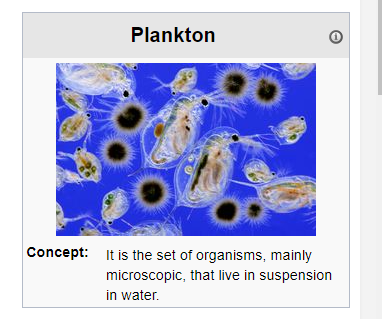
= Plankton . Set of organisms, mainly microscopic, that float in salty or fresh waters, most abundant up to approximately 200 meters deep.
Summary
[ disguise ]
- 1 Features
- 2 Classification
- 1 Zooplankton
- 2 Phytoplankton
- 3 Other classifications
- 3 Migrations
- 4 Role in the food chain
- 5 Red Tide
- 6 Bibliographies
- 7 Sources
Characteristics
Most species are transparent with a certain iridescence, and present colors only under a microscope . The superficial species are bluish, and the others are reddish. Some emit luminescence, such as noctiluca. Most plankton species measure less than a millimeter, others, however, are larger, such as siphonophores, ctenophores and acalepha jellyfish.
Classification
Although plankton has traditionally been subdivided into phytoplankton and zooplankton, according to the most recent classifications this distinction does not seem appropriate, since autotrophic organisms include plants , some protists and bacteria , and heterotrophs include animals, other protists and bacteria. However, this classification is still widely used. A first division can be made between holoplankton, which are those organisms that spend their entire life cycle belonging to plankton, and meroplankton, made up of organisms that only part of their life as part of the planktonic community.
Zooplankton
Consisting of all consumers, the vast majority of which constitute secondary and tertiary producers. This group is made up of generally microscopic adult organisms and their larval stages (holoplankton), and the larval stages of other organisms that, as adults, inhabit the aquatic bottom or the water column but counteract the movement of currents. Some of the most abundant and characteristic groups of zooplankton organisms are copepods, cladocerans, rotifers, cnidarians, chaetognaths, euphausiids and fish larvae, which due to their socioeconomic relevance of juvenile and adult organisms are generally studied and described with the term “ ichthyoplankton.” Like phytoplankton, depending on the environment in which they are found, whether freshwater or marine, each of the groups or species of zooplankton will vary in diversity and abundance. A relatively less studied component of zooplankton is its parasites, which constitute a diversity several orders of magnitude greater than the same phytoplanktonic and zooplanktonic organisms since every organism that exists on the planet is prone to being infested or infected by multiple parasites.
Phytoplankton
Plant plankton, called phytoplankton, a word that derives from the Greek φύτοπλαγκτον [fytoplagton] (φυτον [phyton] means plant), develops in the coastal waters of the sea with sunlight and abundant mineral salts (water up to 30 m deep), since they make their food through photosynthesis. They constitute food for zooplankton and produce 50% of the molecular oxygen necessary for terrestrial life. The most abundant organisms in phytoplankton are cyanobacteria and diatoms, unicellular golden algae. We also find dinoflagellates, responsible for red tides. Base of the marine food chain, phytoplankton has experienced a significant decline due to the increase in ultraviolet radiation . It has been observed that under the ozone hole in Antarctica, phytoplankton productivity decreased between 6% and 12%.
Other classifications
Various authors have made a classification of plankton by size, although it is a division that can be considered “artificial”, since in principle it was based on the mesh size with which the captures were made, and no definitive agreement has been reached. . One of the most used classifications is the following:
- Femtoplankton (0.02-0.2 µm): viruses, bacteria
- Picoplankton (0.2-2 microns): bacteria, cyanobacteria, prasinophyceans
- Nanoplankton (2-20 microns): phytoflagellates
- Microplankton (20-200 microns): diatoms, peridines, tintinins, radiolarians, ostracods, cladocerans
- Macroplankton (0.2-2 mm): jellyfish, fry
- Megaloplankton (greater than 2 mm): jellyfish, tunicate colonies
It can also be classified according to its location (horizontal or vertical)
- Horizontal or distance from the coast:
- Neritic plankton: is that found on the continental shelf.
- Oceanic plankton: is that found outside the continental shelf.
- Vertical or depth:
- Epiplankton: 0-50 meters.
- Subplankton: 50-200 meters.
- Infraplankton: 200-500 meters.
- Batyplankton more than 500 meters below the surface.
Migrations
Plant plankton is always close to the surface of the water , as it needs light to carry out photosynthesis . On the other hand, zooplankton is always in motion, from top to bottom, completing a daily cycle with a distance of between 100 to 500 meters, or more. They are almost always close to the surface at night to feed, and lower during the day to escape strong solar radiation, although it may be reversed for some groups.
Role in the food chain
Phytoplankton is the food of zooplankton. This simultaneously serves as food for echinoderms, crustaceans and fish in the larval stage. When these larvae grow, they serve as food for schools of small fish that in turn feed large planktivores, such as whales or whale sharks, and larger fish that feed, sometimes, in several successive stages, the large oceanic predators, such as They are carnivorous cetaceans, sharks , tunas or swordfish. In proportion, one ton of the latter will have required, for its existence and development, five thousand tons of phytoplankton, as part of what is called the food chain.
red tide
Normally known as “red tides” they are the proliferations of dinoflagellates (phytoplankton) that grow exponentially due to the favorable conditions for their development (temperatures, quality and quantity of light, nutrients and passivity of the water column ). Its reproduction does not stop until conditions are unfavorable. Many times these algal blooms go unnoticed, but it is possible that the bloom is from some type of toxic phytoplankton, such as Alexandrium catenella, which causes death in vertebrates such as humans. Not all blooms turn the water the red color that gives this phenomenon its name. Paradoxically, the most harmful blooms are colorless, which is why experts usually refer to them as “Harmful Algal Blooms” (or HAB).